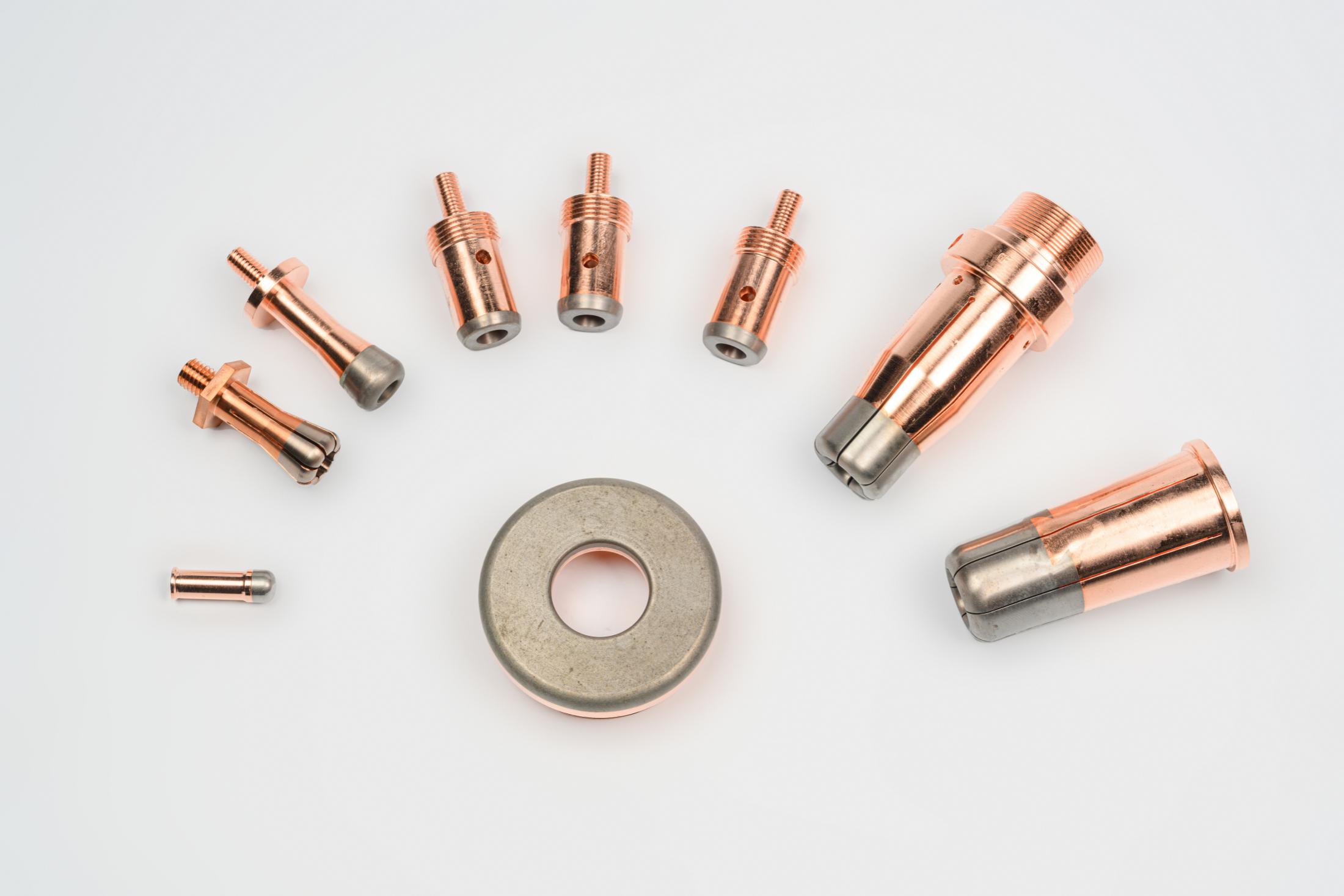
Product Details
CuW Contact Finger
Contact fingers are the spring-loaded contact elements used in plug-in assemblies, the moving side of a draw-out VCB, the touch-and-break contact in disconn...
Technical Description
CuW Contact Finger
Contact fingers are the spring-loaded contact elements used in plug-in assemblies, the moving side of a draw-out VCB, the touch-and-break contact in disconnector assemblies, and similar applications. The CuW tip handles arc duty during making and breaking; the rest of the finger handles the continuous current and the spring action.
We supply two forms: integrated CuW fingers (full CuW length, simpler design but heavier) and CuW-tipped fingers brazed to copper or bronze bodies (lower cost, lighter, more common). Tip grades available in CuW70 / 75 / 80; the body material follows your design.
Specifications
| Property | Value |
|---|---|
| Tip Material Grade | CuW70 / CuW75 / CuW80 |
| Body Material | Copper or bronze (per drawing); or full CuW |
| Form | Spring-action finger with CuW tip |
| Finger Length | Per drawing |
| Tip Length | Per drawing |
| Cross Section | Per drawing |
| Tolerance | Per drawing |
| Surface Treatment | Tip as machined; body silver plated by default |
| Working Voltage | Common MV ratings: 12 / 24 / 40.5 kV |
| Working Current | Per-finger rating depends on design; assembly current is N × finger |
Exact certified properties for your lot are available with material documentation on request.
Applications
- Draw-out VCB plug-in contact assemblies (12 / 24 / 40.5 kV)
- Disconnector and earthing switch contact fingers
- Make-and-break contact elements in MV switchgear cassettes
- Replacement fingers for installed draw-out switchgear fleets
Technical Notes
The CuW tip on a contact finger is the part doing arc work; the rest of the finger is a mechanical and conductive structure. Tip length matters: a longer CuW tip lasts longer through repeated operations but adds cost and weight. Most production designs keep the tip just long enough to outlast the assembly's specified electrical life.
For a brazed assembly (CuW tip + copper body), the braze joint is the weak point if not done right. We braze CuW to copper in-house with copper-silver fillers under controlled atmosphere; joint shear strength is consistent with industry practice for the material pair.
If your design has multiple fingers in parallel (a typical plug-in contact uses 4–12 fingers), the per-finger current rating multiplied by the finger count gives the assembly rating. Each finger should be specified to handle its share, with margin for current sharing imbalance.
Sourcing & OEM
Custom fingers from drawing are routine, whether integrated CuW or CuW-tipped. MOQ, lead time, and plating options vary by specification; contact us with your drawing for a project-specific quote.
Technical FAQ
Common questions about this product.
Do you produce integrated CuW fingers (full CuW length)?
Yes, but most orders are CuW-tipped fingers with copper or bronze bodies: lower cost, lighter, and equally functional for typical MV duty. Integrated CuW is available where the design requires it.
Can you braze CuW tips onto copper finger bodies?
Yes. We braze CuW to copper in-house with copper-silver fillers under controlled atmosphere. Joint shear strength is consistent with industry standards for the material pair.
What tip length do you recommend?
Tip length depends on the assembly's specified electrical life. Longer tips outlast the assembly with margin; shorter tips minimize cost. We can recommend a tip length based on your operating cycles and breaking current; supply this with your inquiry.
Are the finger bodies silver plated?
By default, copper or bronze finger bodies are silver plated to lower contact resistance at the carrier interface. The CuW tip stays bare. Specify if your design needs different plating.
What is the typical lead time?
Lead time varies by grade, dimensions, plating, and order volume. Contact us with your specifications for a project-specific timeline.
You May Also Like
Related Products
Similar components you may need.