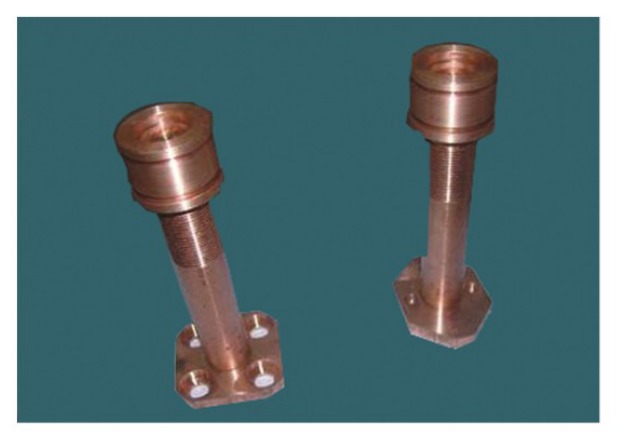
Bronze Bushing for MV Switchgear
Bronze bushings support moving shafts and provide bearing surfaces in MV switchgear operating mechanisms, the shaft that drives a moving contact, the pivot...
Bronze and aluminum bronze components fill the spaces in MV switchgear where copper is too soft and CuW is overkill : bushings, contact fingers, commutator plates, and the small precision parts that make breaker and disconnector assemblies work. Bronze alloys offer better mechanical strength than pure copper while keeping useful conductivity, and they handle sliding contact wear that would gall copper-on-copper. We supply bronze components for MV switchgear builds and refurbishment programs: standard parts like bushings and contact fingers, plus custom machined components from drawing. Aluminum bronze (C95400 series) is our most common alloy; phosphor bronze (C51000 / C52400) and brass (C26000 / C28000) are used for specific applications.
Bronze bushings support moving shafts and provide bearing surfaces in MV switchgear operating mechanisms, the shaft that drives a moving contact, the pivot...
Commutator plates are the segmented contact elements in commutator-style switching mechanisms, older MV switchgear designs that use a rotating or stepping c...
Bronze contact fingers are spring-loaded contact elements where the body and spring action are combined in one piece. The bronze alloy is hard enough to act...
Bronze precision part is the catch-all listing for bronze components that don't fit the standard form factors, bushing, contact finger, ring, commutator plate.
Bronze rings appear in MV switchgear contact assemblies in a few related roles: as spring carriers in tulip contact assemblies (holding the radial spring ten...
"Bronze" on a drawing is not a specification. The alloy decides whether the part survives, and the four families we machine behave differently enough that substituting one for another is a real risk.
| Alloy | Character | Where it lands |
|---|---|---|
| C95400 aluminum bronze | Hardest, best wear and galling resistance, lowest conductivity of the four | Our most common alloy. Sliding-contact and bearing duty: bushings, guide elements, wear rings |
| C51000 / C52400 phosphor bronze | Springy, good fatigue life, holds contact force through cycling | Spring-loaded parts: contact fingers, spring carriers |
| C26000 / C28000 brass | Cheapest to machine, adequate conductivity, poor wear | Non-wearing hardware where cost per piece dominates |
| Pure copper | Highest conductivity, too soft for sliding duty | Not bronze — see conductive rods and conductors |
The single most common specification error we see is aluminum bronze called out for a spring-loaded finger. C95400 is hard and it does not spring; the finger loses contact force after a few thousand cycles. The bronze selection guide works through the failure modes.
Most of the bronze work we quote is not a catalogue item. It is a drawing for a part that only exists inside one manufacturer's assembly — a ring with a specific groove profile, a commutator plate for a switchgear design that went out of production twenty years ago, a bushing with a non-standard flange.
That is the normal case here, not the exception. Bronze precision machined components is the listing for anything outside the standard forms: CNC turned and milled from bar or from castings, to your drawing, in the alloy you specify or the one we recommend.
Bronze rings, bushings, and wear elements outside MV switchgear are quoted the same way. The alloy behaviour does not change because the assembly is a gearbox rather than a breaker — send the drawing and the duty.
Yes, and for obsolete parts it is often the only option. A sample plus the alloy (or permission to test it) plus the quantity is enough to start. Say which dimensions are functional and which are cosmetic — reverse engineering a worn part otherwise reproduces the wear.
We machine, from bar stock or from supplied castings. Parts that only make sense as castings are quoted through the casting route with machining after.
Material certificates come with the shipment. If the alloy matters to your own approval process, say so before the order — the certificate has to be requested from the mill at purchase time, not reconstructed afterwards.