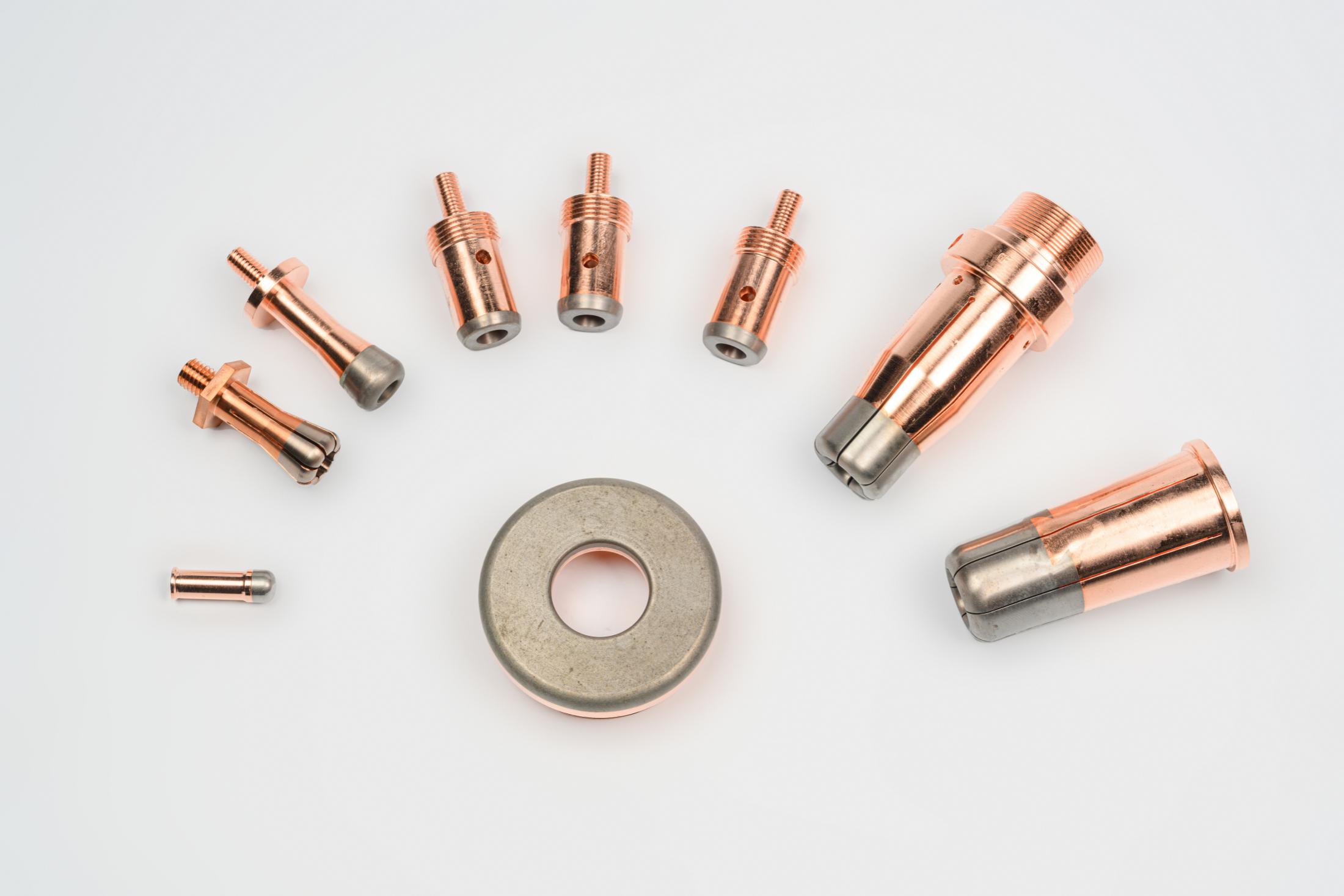
Product Details
CuW Contact Plate
CuW contact plate is a flat or stepped CuW element used where a contact assembly needs more surface area than a round contact can provide.
Technical Description
CuW Contact Plate
CuW contact plate is a flat or stepped CuW element used where a contact assembly needs more surface area than a round contact can provide. Common applications include earthing switch contacts, plate-style static contacts in larger MV switchgear, and braze-on inserts for copper carrier assemblies. Standard grades are CuW70, CuW75, and CuW80, machined from drawing.
The plate form trades the radial symmetry of rod-based contacts for surface flexibility. You get a contact face shaped to your assembly rather than constrained to a round disc.
Specifications
| Property | Value |
|---|---|
| Material Grade | CuW70 / CuW75 / CuW80 |
| Tungsten Content | 70, 75, or 80 wt% |
| Form | Flat or stepped plate (machined to drawing) |
| Thickness Range | Per drawing |
| Plan-View Dimensions | Per drawing |
| Tolerance | Per drawing |
| Surface Treatment | As machined; polishing or plating optional |
| Electrical Conductivity | 32–45% IACS depending on grade (per ASTM B702 typical) |
| Density | 13.0–15.0 g/cm³ depending on grade |
| Working Voltage | Common MV ratings: 12 / 24 / 40.5 kV |
| Working Current | Application-specific; confirmed per design |
| Features | Holes, slots, chamfers per drawing |
Exact certified properties for your lot are available with material documentation on request.
Applications
- Earthing switch contacts in MV switchgear (12 / 24 / 40.5 kV classes)
- Plate-form static contacts in larger MV / HV switchgear panels
- Braze-on CuW inserts for copper or bronze carrier assemblies
- Custom contact plates for sub-supply to VCB and isolator manufacturers
Technical Notes
CuW plate machining is similar to rod stock: carbide tooling, slower feed rates than pure copper, and post-machining surface conditioning where the arc face matters. Thicker plates have more thermal mass and tolerate higher single-event arc energy; thinner plates respond faster thermally but erode more per event.
For braze-on assemblies, plate thickness should account for the post-braze finish dimension, if your assembly is ground to a final thickness after brazing, order the plate slightly oversize. We can quote either net-shape or with braze allowance; specify in your order.
Holes, slots, and edge features should appear on the drawing. CuW is harder than copper but can carry features without unusual difficulty if the tooling is right.
Sourcing & OEM
Custom plates from drawing are routine. MOQ, lead time, and surface treatment options vary by specification; contact us with your drawing for a project-specific quote.
Technical FAQ
Common questions about this product.
What plate thickness ranges do you produce?
Standard thickness ranges and plan-view dimensions are available on request. Custom dimensions are produced to order.
Can you machine holes and slots into the plate?
Yes. Features per drawing: holes, slots, chamfers, and steps are all routine. Send the DXF / PDF / STEP.
Is polishing or plating available?
Yes. Bright polishing on the contact face is available; silver or nickel plating on non-arcing surfaces also available. Specify in your order.
Can plates be supplied with braze allowance?
Yes. Specify net-shape or with-allowance dimensions in your order. Both are routine.
What is the typical lead time?
Lead time varies by grade, dimensions, features, and order volume. Contact us with your spec for a project-specific timeline.
You May Also Like
Related Products
Similar components you may need.