Product Details
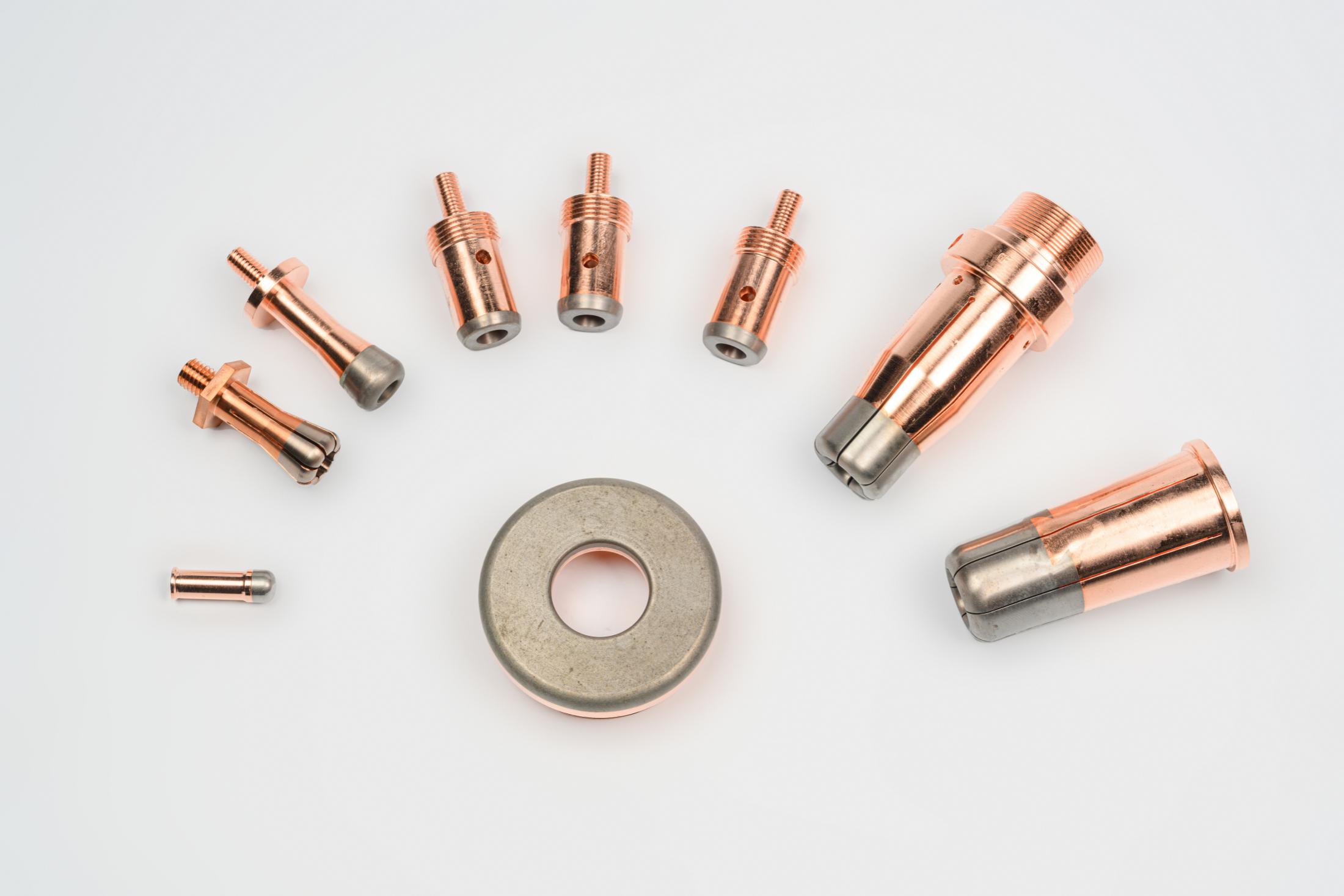
CuW Static Arc Contact
The static arc contact is the fixed-side contact in a vacuum interrupter.
Technical Description
CuW Static Arc Contact
The static arc contact is the fixed-side contact in a vacuum interrupter. When the breaker opens, an arc forms briefly between the static and moving contacts; the CuW alloy is what survives that arc without significant erosion. We produce static arc contacts in CuW70, CuW75, and CuW80, in standard rod-form geometries and custom shapes machined from drawing.
Static contacts pair with the corresponding moving arc contact; for VCB builds and refurbishment we can supply either individual components or matched pairs. See our CuW Arc Contact Pair for set ordering.
Specifications
| Property | Value |
|---|---|
| Material Grade | CuW70 / CuW75 / CuW80 |
| Tungsten Content | 70, 75, or 80 wt% |
| Form | Machined static contact (round, stepped, or to drawing) |
| Dimensions (OD × L) | Per drawing |
| Tolerance | Per drawing |
| Electrical Conductivity | ≥42% IACS (CuW70) / ≥38% (CuW75) / ≥34% (CuW80) — per GB/T 8320-2025 |
| Density | ≥13.80 / 14.50 / 15.15 g/cm³ for CuW70 / 75 / 80 |
| Hardness (HB) | ≥175 / 195 / 220 for CuW70 / 75 / 80 |
| Bending Strength | ≥790 / 885 / 980 MPa for CuW70 / 75 / 80 |
| Gas Content (vacuum switch grade) | O ≤0.008%, N ≤0.002% per GB/T 8320-2025 |
| Surface Treatment | As machined; silver or nickel plating optional |
| Working Voltage | Common MV ratings: 12 / 24 / 40.5 kV |
| Working Current | Application-specific; confirmed per design |
Exact certified properties for your lot are available with material documentation on request.
Applications
- Fixed-side arc contact in 12 kV, 24 kV, and 40.5 kV vacuum interrupters
- MV vacuum circuit breaker (VCB) original equipment and refurbishment
- Replacement contacts for installed VCB fleets in substations and industrial switchgear
- Custom static contacts brazed onto copper carriers for OEM contact assemblies
Technical Notes
The static contact's job is to hold position while the moving contact opens; arc duty is split with the moving side but the static face takes a comparable share of erosion. Surface finish matters: a rougher face can locally concentrate arc current and accelerate pitting, so post-machining surface conditioning is part of our standard process. For high-cycle applications, silver plating on non-arcing surfaces reduces contact resistance at the carrier interface; the arc face itself stays bare CuW.
If you're brazing the static contact onto a copper carrier in-house, we can supply rod blanks slightly oversize for your braze allowance; specify when ordering.
Sourcing & OEM
Custom-machined to your drawing is routine — provide DXF / PDF / STEP and we'll confirm feasibility and quote. Plating, MOQ, and lead time vary by specification; contact our engineering team with your drawing or sample for a project-specific quote.
Technical FAQ
Common questions about this product.
What grades of CuW do you offer for static arc contacts?
We supply CuW70, CuW75, and CuW80. CuW70 is the most common choice for general MV vacuum interrupter duty; CuW75 and CuW80 are specified when arc-erosion resistance takes priority over conductivity.
Can you machine static arc contacts to my drawing?
Yes. Most of our orders are custom geometries from drawing rather than catalog parts. Send DXF / PDF / STEP and we'll confirm feasibility.
What is the typical lead time?
Lead time varies by grade, dimensions, plating, and order volume. Contact us with your specs for a project-specific timeline.
Do you offer silver or nickel plating on static arc contacts?
Yes, on request. The arc face is normally left as machined; plating typically goes on non-arcing surfaces to lower contact resistance at the carrier interface.
Are your static arc contacts compatible with major VI brands?
If you supply the drawing or a sample from the existing part, we can produce a dimensional match. We don't claim direct interchangeability with named brands by reference. The drawing is the contract.
What is the typical electrical life of a CuW static arc contact?
Electrical life depends heavily on application: operating frequency, breaking current, voltage class, and ambient conditions. We can discuss expected life for your specific application; specific life-cycle data per grade is available on request.
How do I request a sample for evaluation?
Email sales@tungarc.com with the drawing or specification and intended application. We can typically arrange evaluation samples for serious sourcing programs.
You May Also Like
Related Products
Similar components you may need.