Product Details
Aluminum Bronze Rod
Aluminum bronze rod is the conductor material where mechanical strength and wear resistance matter alongside conductivity, typically in sliding-contact appl...
Technical Description
Aluminum Bronze Rod
Aluminum bronze rod is the conductor material where mechanical strength and wear resistance matter alongside conductivity, typically in sliding-contact applications, rotating-contact assemblies, and mechanical components that double as current paths. C95400 (Al 11% / Fe 4%) is the workhorse alloy; C95500 (with nickel) for higher-strength applications; C95800 (with iron and manganese) for the most demanding mechanical duty.
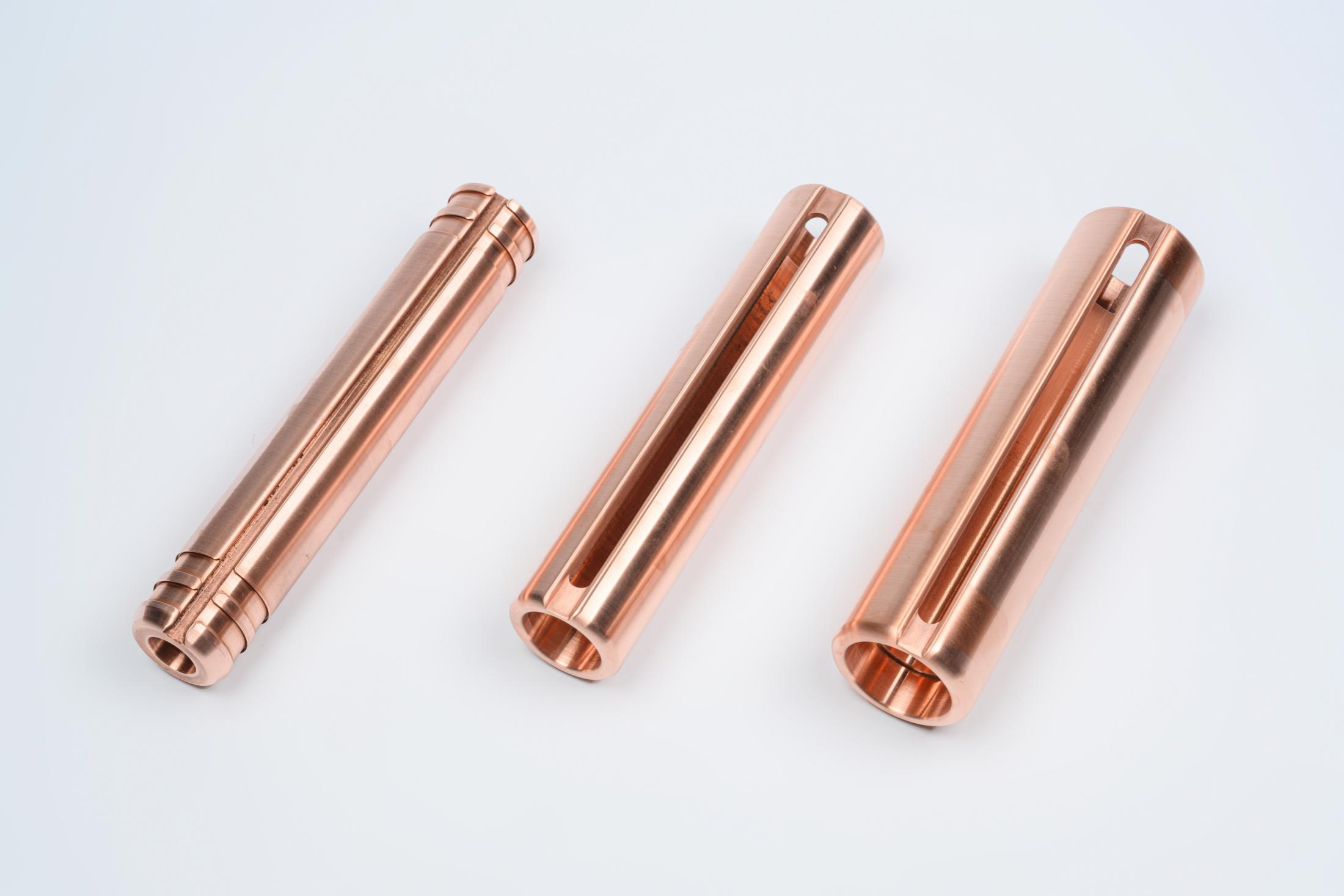
For raw copper rod (higher conductivity, lower mechanical strength), see Copper Conductive Rod. For pre-machined conductor elements, see Copper Conductor Element.
Specifications
| Property | Value |
|---|---|
| Material | Aluminum bronze C95400 (default); C95500 / C95800 on request |
| Form | Round bar (rod) |
| Diameter Range | Per drawing / specification |
| Length Range | Per drawing / specification |
| End Condition | Sawn (default); faced or chamfered on request |
| Tolerance | Standard machining tolerance |
| Conductivity | 10–15% IACS (C95400 typical) |
| Density | 7.45 g/cm³ (C95400) |
| Hardness (HB) | 150–200 (C95400 typical, depending on temper) |
| Tensile Strength | Significantly higher than pure copper (per ASTM B505) |
| Corrosion Resistance | Excellent in atmospheric and marine environments |
Exact certified properties for your lot are available with material documentation on request.
Applications
- Sliding contact conductors in MV disconnector and isolator assemblies
- Rotating contact segments where mechanical wear resistance matters
- Mechanical conductor components in 12 / 24 / 40.5 kV switchgear
- Replacement aluminum bronze conductor stock for refurbishment programs
Technical Notes
The choice to use aluminum bronze instead of copper for a conductor is a deliberate trade-off: roughly 10–15% IACS conductivity vs 100% for copper, but several times the mechanical strength and dramatically better wear resistance. For an MV switchgear conductor that flexes, rotates, or slides, the wear advantage usually wins; for a static current path, copper wins on conductivity.
C95400 vs C95500: the C95500 alloy adds nickel for higher strength, useful in heavy mechanical duty but at the cost of more difficult machining. For most MV switchgear applications, C95400 is the default. C95800 is rarely needed unless the application is unusually demanding.
Aluminum bronze machining is slower than copper machining. The alloy is harder. Carbide tooling and moderate feed rates are normal. Surface finish post-machining is usually good without secondary operations.
Sourcing & OEM
Standard diameters and lengths produced to order. Custom dimensions and end conditions per drawing. Contact us with your specification for a project-specific quote.
Technical FAQ
Common questions about this product.
Aluminum bronze vs copper, when to use which?
Aluminum bronze for sliding wear, rotating contact, and mechanical conductor duty. Copper for static current paths where conductivity matters most. For your application, send the design and we can recommend.
Which aluminum bronze alloy is your default?
C95400, the general-purpose alloy for MV switchgear applications. C95500 (with nickel) for higher-strength duty; C95800 for the most demanding mechanical applications.
Are rods supplied with faced ends?
Default is sawn. Faced or chamfered ends available on request.
Can you supply pre-plated rods?
Silver plating on contact surfaces available; specify thickness in your order.
What is the typical lead time?
Lead time varies by alloy, dimensions, and quantity. Contact us with your specifications.
You May Also Like
Related Products
Similar components you may need.