Product Details
Moving Contact Conductor
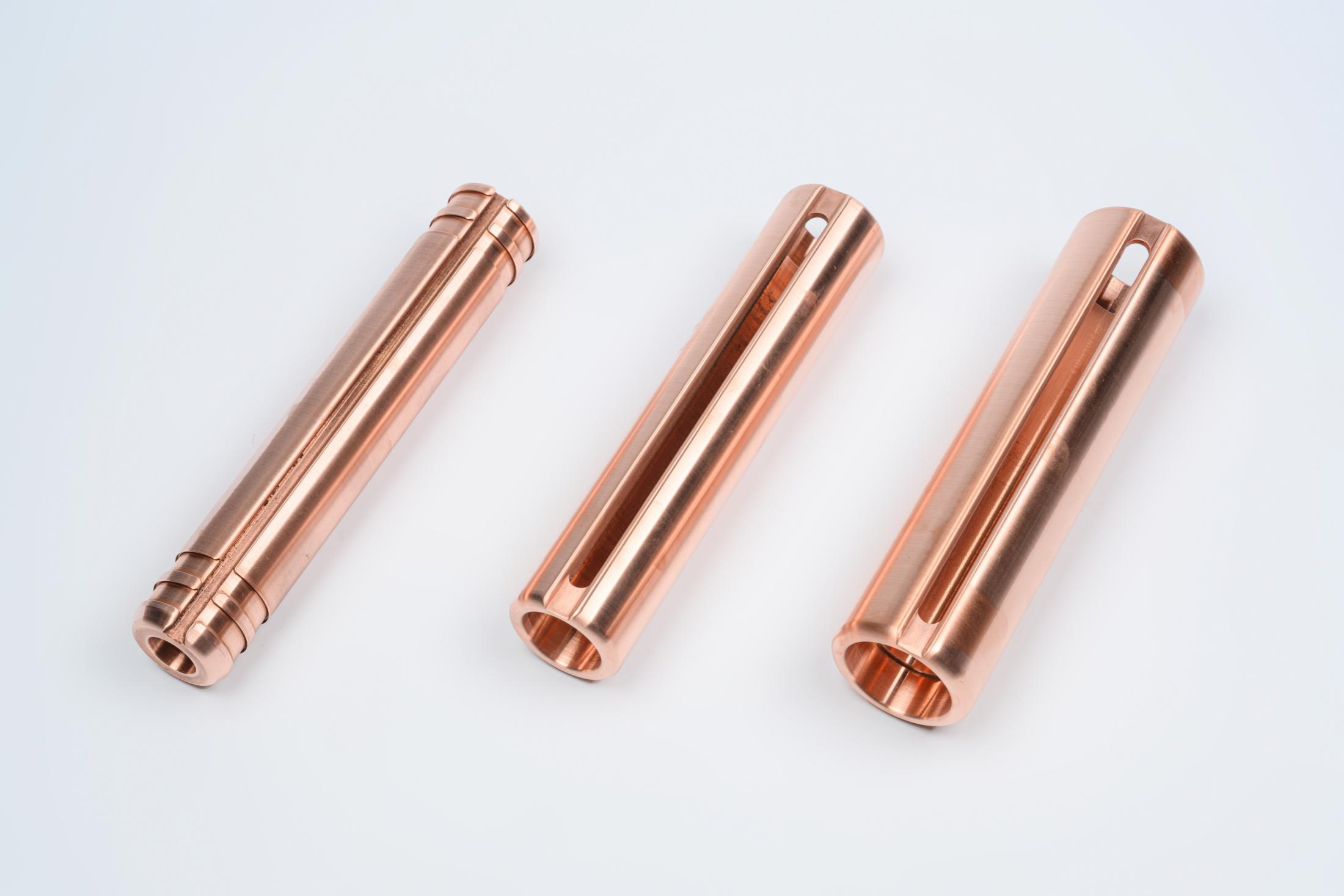
The moving contact conductor is the rod connecting an MV breaker's operating mechanism to the moving contact face. It carries the breaker's continuous curre...
Technical Description
Moving Contact Conductor
The moving contact conductor is the rod connecting an MV breaker's operating mechanism to the moving contact face. It carries the breaker's continuous current during normal operation and the arc current during opening / closing. Most designs use a pure copper conductor with a CuW or copper alloy contact face brazed at the end. The conductor sees both electrical and mechanical duty: continuous current load, plus the impact and motion of operator-driven opening and closing.
This SKU covers the conductor segment specifically. For the moving contact face (the part that mates with the static contact during closing), see CuW Moving Arc Contact. For complete moving contact sub-assemblies (conductor + contact face brazed together), specify both in your order.
Specifications
| Property | Value |
|---|---|
| Material | ETP copper C11000 (default); aluminum bronze C95400 on request for high-cycle mechanical duty |
| Form | Cylindrical conductor (often stepped, with flange or thread) |
| Dimensions | Per drawing |
| Tolerance | Per drawing |
| Mechanical Interface | Bolt, weld, braze, or threaded, per drawing |
| Contact Face | Bare copper, silver-plated, or pre-brazed CuW tip |
| Conductivity | 100% IACS (C11000) or 10–15% IACS (C95400 if used) |
| Working Voltage | Common MV ratings: 12 / 24 / 40.5 kV |
| Working Current | Sized per VCB design rated current |
Exact certified properties for your lot are available with material documentation on request.
Applications
- Moving contact conductor in 12 / 24 / 40.5 kV vacuum circuit breakers
- Operating mechanism connection rod in MV breaker assemblies
- Conductor for sub-supply to VCB assemblers building moving contact systems
- Replacement conductors for installed breaker fleets
Technical Notes
The moving contact conductor sees two duty cycles. Electrical: continuous current during normal operation, plus arc current at the brazed-on CuW tip during opening or closing. Mechanical: impact at each operation and continuous mechanical force from the spring-loaded operating mechanism. Material choice usually goes pure copper for the conductor section (high conductivity, sufficient mechanical strength) with a CuW or bronze face at the contact end.
For VCB designs where the operating mechanism interface is a threaded or welded joint, specify the joint geometry along with the conductor drawing. Thermal expansion during fault current events can stress these joints; the joint design has to accommodate it.
For high-cycle applications where the conductor sees significant mechanical fatigue, aluminum bronze C95400 is an alternative with better fatigue resistance. The trade-off is lower conductivity; size up the cross-section to compensate.
Sourcing & OEM
Custom moving contact conductors to your drawing are routine. Specify the material, dimensions, interface conditions, and any pre-brazed contact face; contact us for a project-specific quote.
Technical FAQ
Common questions about this product.
Is the CuW contact face pre-brazed by default?
It depends on what you order. The conductor alone ships without a contact face. If you specify a complete moving contact sub-assembly (conductor + CuW face), we braze and supply the assembly. Discuss preference when ordering.
What material for the conductor itself?
ETP copper C11000 by default, highest conductivity at the lowest cost for MV switchgear duty. Aluminum bronze C95400 on request for high-cycle mechanical applications, with cross-section sized up to compensate for lower conductivity.
What interfaces do you machine into the operating mechanism end?
Bolt, weld preparation, braze allowance, threaded, all per drawing. Specify the interface type and dimensions with your order.
Can you supply complete moving contact sub-assemblies?
Yes. Conductor + CuW contact face brazed together as a single assembly is routine. Specify both drawings.
What is the typical lead time?
Lead time depends on complexity, interface conditions, and pre-brazed assembly requirements. Contact us with your specifications.
You May Also Like
Related Products
Similar components you may need.