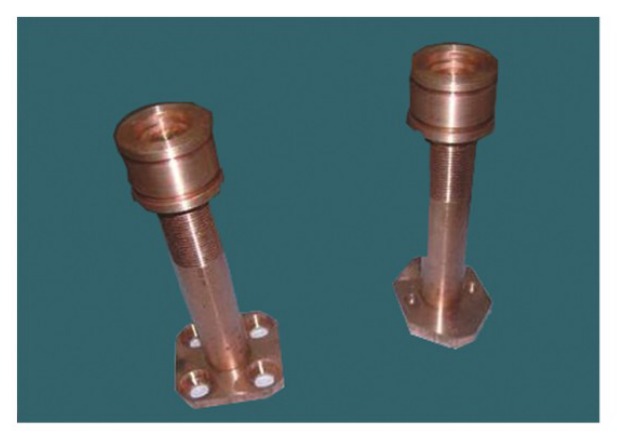
Product Details
Bronze Commutator Plate
Commutator plates are the segmented contact elements in commutator-style switching mechanisms, older MV switchgear designs that use a rotating or stepping c...
Technical Description
Bronze Commutator Plate
Commutator plates are the segmented contact elements in commutator-style switching mechanisms, older MV switchgear designs that use a rotating or stepping contact instead of a linear make-and-break action. Bronze (typically aluminum bronze or phosphor bronze) is the standard material because the plates see sliding contact under load: the brush or contact wiper moves across the plate face, and bronze resists wear at the sliding interface better than pure copper.
This SKU primarily serves refurbishment of legacy MV switchgear installations. New designs rarely use commutator-style switching, but installed fleets need replacement plates as the contact faces wear.
Specifications
| Property | Value |
|---|---|
| Alloy | Aluminum bronze C95400 or phosphor bronze C51000 (per drawing) |
| Form | Flat or curved segment plate (machined to drawing) |
| Plate Thickness | Per drawing |
| Plan View Dimensions | Per drawing |
| Surface Finish | Machined; polished contact face optional |
| Conductivity | 10–20% IACS depending on alloy choice |
| Hardness (HB) | 75–200 depending on alloy and temper |
| Mounting Features | Holes, slots, locating pins per drawing |
| Working Voltage | Common MV ratings: 12 / 24 kV (legacy designs) |
Exact certified properties for your lot are available with material documentation on request.
Applications
- Segmented contact element in commutator-style MV switching mechanisms
- Replacement plates for installed legacy switchgear refurbishment
- Custom commutator components for specialized switching applications
- Sub-supply to refurbishment service companies maintaining commutator equipment
Technical Notes
Commutator plates handle sliding contact under load. The contact wiper or brush moves across the plate face during switching, and the load current flows through that moving interface. Plate surface finish matters: a polished contact face has lower initial contact resistance but wears differently than an as-machined surface; specify based on the original equipment design.
For legacy refurbishment, exact dimensional match to the original plate is more important than material optimization. If the original plates were aluminum bronze and you're sourcing replacements, stay with aluminum bronze even if phosphor bronze would technically perform better.
Sourcing & OEM
Custom commutator plates to your drawing are routine. Most orders are for legacy refurbishment, send the original drawing or a sample plate; we'll match dimensions and finish.
Technical FAQ
Common questions about this product.
What alloy is typical for commutator plates?
Aluminum bronze (C95400) or phosphor bronze (C51000) are most common. Choose based on the original equipment design rather than first-principles material selection.
Are commutator plates still used in new MV switchgear designs?
Rarely. Most modern MV switchgear uses linear make-and-break contact mechanisms (VCB, contactor) rather than commutator-style switching. The volume here is refurbishment of installed legacy fleets.
Can you produce plates to a sample if I don't have the original drawing?
Yes. Send the sample; we'll scan, measure, and produce to a drawing we generate. IP terms during quoting, we treat customer parts as confidential.
Is the contact face polished?
Default is as machined. Polished contact face is available; specify in your order. Match the surface finish to the original equipment for best refurbishment compatibility.
What is the typical lead time?
Lead time varies by alloy, dimensions, features, and quantity. Contact us with your specifications for a project-specific timeline.
You May Also Like
Related Products
Similar components you may need.