Product Details
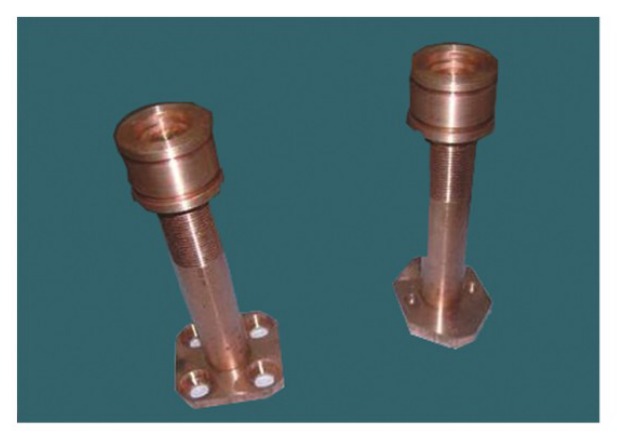
Bronze Contact Finger
Bronze contact fingers are spring-loaded contact elements where the body and spring action are combined in one piece. The bronze alloy is hard enough to act...
Technical Description
Bronze Contact Finger
Bronze contact fingers are spring-loaded contact elements where the body and spring action are combined in one piece. The bronze alloy is hard enough to act as the spring while still conducting current. This contrasts with the CuW Contact Finger, where a CuW tip handles arc duty on a copper or bronze body, and with copper fingers, which need a separate stainless or bronze spring behind them.
Phosphor bronze (C51000, C52400) is the typical alloy when spring action matters most. Aluminum bronze (C95400) shows up when the finger sees sliding wear under load and mechanical durability matters more than spring rate.
Specifications
| Property | Value |
|---|---|
| Alloy | Phosphor bronze C51000 / C52400 (spring duty); aluminum bronze C95400 (wear duty) |
| Form | Spring-action finger (single piece, no separate spring) |
| Finger Length | Per drawing |
| Cross Section | Rectangular or shaped, per drawing |
| Tolerance | Per drawing |
| Surface Treatment | As machined or silver-plated on contact face |
| Conductivity | 11–20% IACS depending on alloy |
| Hardness (HB) | 75–225 depending on alloy and temper |
| Working Voltage | Common MV ratings: 12 / 24 / 40.5 kV |
| Working Current | Per-finger rating depends on cross-section and alloy |
Exact certified properties for your lot are available with material documentation on request.
Applications
- Spring-action finger contacts in MV switchgear where the alloy provides both spring and current path
- Sliding contact elements in disconnector and isolator assemblies
- Contact fingers for applications where mechanical durability matters more than minimum contact resistance
- Replacement fingers for installed switchgear refurbishment
Technical Notes
The choice between phosphor bronze and aluminum bronze depends on duty cycle. Phosphor bronze has the better spring properties, higher elastic limit relative to its strength, so it returns to shape after repeated flexing. Aluminum bronze is harder and more wear-resistant but doesn't spring as well; use it where the finger sees sliding wear rather than repeated insertion cycles.
For most plug-in spring-finger applications, phosphor bronze C51000 or C52400 (the higher-tin variant) is the right starting point. For sliding-wear applications, aluminum bronze C95400 wins on service life despite lower conductivity.
Silver plating on the contact face is normal for low-resistance applications. The bronze underneath handles the mechanical work; the silver handles the electrical interface. Plating wears over insertion cycles; thickness specification matters for life.
Sourcing & OEM
Custom bronze contact fingers to your drawing are routine. Specify the alloy choice and any silver plating; contact us with your drawing for a project-specific quote.
Technical FAQ
Common questions about this product.
Phosphor bronze vs aluminum bronze for contact fingers, which should I use?
Phosphor bronze (C51000, C52400) for spring duty, repeated flexing, plug-and-unplug action. Aluminum bronze (C95400) for sliding wear duty, disconnector contacts, isolator fingers. For new designs, send your duty cycle and we can recommend.
How does this compare to CuW Contact Finger?
The CuW Contact Finger handles arc duty (making and breaking under load). The CuW tip resists arc erosion. Bronze contact fingers handle sliding or spring-action duty without arc: lower cost, no CuW tip, and the bronze alloy serves both spring and conduction.
Is silver plating standard?
Not by default, bronze fingers ship as machined. Silver plating on the contact face is available for low-resistance applications; specify thickness in your order.
Can you produce to a legacy OEM finger drawing?
Yes. Most legacy refurbishment orders work from the original drawing or a sample. Send what you have with your inquiry.
What is the typical lead time?
Lead time varies by alloy, dimensions, plating, and quantity. Contact us with your specifications for a project-specific timeline.
You May Also Like
Related Products
Similar components you may need.